Monday, December 12, 2011

Psychology

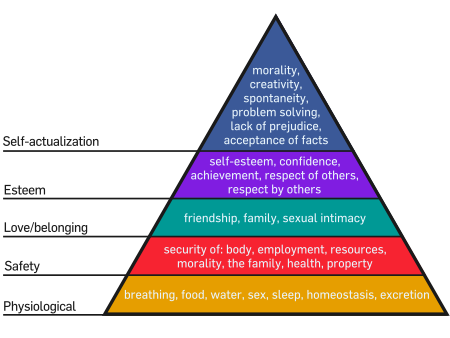
 Maslow's hierarchy of human needs

Chip Conley: The 5 Things Everyone Wants From You


Joie de Vivre Hotels’ founder explains how your customers, your employees, and even your investors have the same five needs. Deliver on them and you can’t lose.


 You may remember Maslow from introductory college psych courses, as the creator of Maslow's hierarchy of human needs. In Maslow’s model, there are five levels. In order of urgency they are:
  • physiological (like food and shelter)
  • safety
  • belonging
  • esteem
  • self-actualization
Until the lower-level needs are met, a person isn’t interested in moving up the chain to the next. The higher you go in the hierarchy, the more secure, happier and fulfilled you become.  

Starup stages


 Great Vieo  -- for Lean Starup


Should you launch at a conference?  - very good insight on Product Launch ( they worked 9 months for Trello )

by Joel Spolsky


How to Pitch a VC: 11 Insider Secrets


STARTUP MORE THAN BRAIN, MORE THAN MONEY, MORE THAN WORK HARD.
STARTUP IS VISION.
STARTUP IS MAKE FIST OF CODE, PUT IT THROUGH THE WORLD.
VISION IS PUT FIST IN RIGHT PLACE, BREAK WORLD IN HALF.


VISION IS SEE WHAT OTHERS NOT, DO WHAT OTHERS WON'T, WIN WHEN OTHERS CAN'T.
VISION NOT A BULLETPOINT. NOT GO IN SPREADSHEET. THERE NO ALGORITHM FOR AWESOME.

SMART STARTUP BUILD, ITERATE, FAIL FAST.
WITHOUT VISION FAIL FAST IS JUST LOTS OF FAIL.
VISION NOT HOW. VISION IS WHERE. TAKE EVERYTHING YOU DOING THAT NOT MOVE TOWARDS VISION. 

STARTUP IS SEE WINDOW, START BUILDING WINGS.
VISION IS JUMP OUT WINDOW, TRUST WINGS HAPPEN BEFORE GROUND.


---------------------------------------

Fundraising: See Investors Early and Often

asr: see this kind of guys are available for advice ..

- Set a minimum level. I like $25k; if you need $250k the max number of people you have to keep informed is 10, which is manageable. 
Raise money on a rolling basis, meaning, don't create a deal where you have to wait for all the checks to come in. Structure it so you can deposit checks and get to work, rather than having to aggregate dollars.


Burn Rates: How Much?
Stage                         Team size    Burn Rate             funding
----------------         ----------     --------              --------------
1/ Building Product             5              $50k/mon         $600k  at 3mm post
2/ Building Usage              10             $100k/mon         $1.8 M at 9mm post
3/ Building The Business    25             $250k/mon        $4  MM  at 20mm post

Based on the burn rates above, this would suggest 12 months, 18 months, and 16 months of runway respectively at each stage.


1 product: / Most MVPs can be built by a team of three or four engineers, a product manager, and a designer.
2  Usage: / This is the stage after release, when you are focused in iterating the product, scaling the system for more users, and marketing the product to new users. 
 This can be done by the same team that built the product with 
 - a few more engineers, a community manager, and maybe a few more dollars for this and that.
3 Business:This is when you've determined that your product market fit has been obtained and you now want to build a business around the product or service. You start to hire a management team, a revenue focused team, and some finance people. 

Sunday, December 11, 2011

GRPN LNKD


GRPN Valuation:

1/ The big picture is this:
  • Groupon generated ~$300 million of revenue last year and should generate about $1.7 billion of revenue this year.
  • Groupon is now operating basically at break-even, with the North American business earning a modest profit and the international business losing a modest amount.
  • Groupon is cash-flow positive and has ~$1 billion in the bank
  • Groupon's growth rate is decelerating sharply, and this deceleration is likely to continue for at least several more quarters.


Based on my experience (15 or so years of following tech stocks), that last factor is very important. "Momentum" investors HATE deceleration. And momentum investors have a big impact on the prices at which stocks trade. So we need to keep the deceleration in mind.
In fact, let's start with the deceleration, because it will have a big impact on our fundamental estimates for the next couple of years.
2/ The reason Groupon's growth is decelerating is:
  1. the law of large numbers — the company's already huge, and
  2. the company is cutting back on marketing spending
The second factor is very important. To become meaningfully profitable, Groupon will have to continue to clamp down on marketing. And this will likely lead to further deceleration.

3/  Price Forecast: So what does that give us for preliminary estimates?
2012
Revenue: ~$2.5 billion
Operating Profit (assuming 10% margin): $250 million
Net Income (assuming 35% tax rate): ~$150 million
2013
Revenue: ~$3 billion
Operating Profit (assuming 15% margin): ~$450 million
Net Income (assuming 35% tax rate): ~$300 million
So what might the stock be "worth" on those estimates?
A fast-growing market-leader with a huge global opportunity should eventually trade at 20X-30X earnings. More in the early years, when the growth rate is faster and the company has not yet achieved its steady-state profit margin, less in the later years.
So if Groupon were to trade at, say, 20X-30X 2013 earnings of $300 million, it would trade in a valuation range of $6 billion to $9 billion, with a central value of $7.5 billion. This would equate to a range of about $9-$13 per share.
Notably, that's well below where the stock is trading.
So ... Groupon Already Looks Overvalued


4/ Historical Perspective : Amazon
From 1996-2000, Amazon grew like a bat out of hell, in part because it was spending boatloads of money on marketing. In 2000, however, the funding markets for unprofitable Internet companies dried up, and Amazon had to change tack and focus on becoming profitable. This transition took two years, from 2000-2002. It led to major deceleration in the business. And it was absolutely brutal on Amazon's stock price.

Specifically, as Amazon cut back on marketing spending and other profligate expenses in its drive to become profitable, the stock collapsed more than 95%, from $100+ to, if memory serves, about $6 a share.  See the right half of the chart below.


___________________________________________________________________________________


LinkedIn netted a pair of stock-recommendations rating upgrades from Morgan Stanley and J.P. Morgan Chase & Co. Tuesday, while Bank of America Merrill Lynch raised its 2012 and 2013 earnings and sales estimates.
All three banks served as underwriters for LinkedIn's initial public offering in May. Morgan Stanley Investment Management Inc. holds nearly a quarter of LinkedIn's shares valued at roughly $1.6 billion and is LinkedIn's largest shareholder, according to FactSet.
Shares of LinkedIn rose 4.5% to $73.10 afternoon trading Tuesday, up 62% from their IPO price of $45.
Through Monday, LinkedIn's shares had tumbled 20% since the company announced its secondary stock offering on Nov. 3.
LinkedIn's float could triple to 28 million from 9 million by the end of the year, according to Evercore Partners. More than 8 million shares are likely to come to market in February, with the expiration of additional lock-up extensions.
Morgan Stanley raised its stock-recommendation rating to "overweight" from "equalweight" and established a 12-month price target of $100, the highest among all analysts, according to FactSet.
J.P. Morgan Chase & Co. analyst Doug Anmuth raised LinkedIn's stock recommendation to "overweight" form "neutral," but lowered its 12-month price target $84 from $98, noting that the recent stock declines make the stock's current price "more compelling."
Bank of America Merrill Lynch analyst Justin Post raised estimates for LinkedIn's 2012 and 2013 revenue forecast by 7.6% and 8%, respectively. Bank of America kept its "buy" rating on LinkedIn's shares, and maintained a $92 price target.


Tuesday, December 6, 2011

Trading Wisdom from Gurus

List of big Gurus posts in this blog post:


1/ Brett Steenbarger  Phd Psychology
2/  Dr. Doug Hirschhorn  PhD Sports Psychology
3/ Steve Palmquist

Interview By Kirk
1/ Credits: Dr. Doug Hirschhorn  PhD Sports Psychology:
At the moment I am currently on retainer as the trading psychology coach for several major banks (i.e. Credit Suisse, Deutsche Bank) 
- . I am also on retainer with several multi-billion dollar macro and fixed income hedge funds
- . My coaching practice focuses on improving the performance of elite traders, large portfolio managers and principals of hedge funds.
Dr. Doug Hirschhorn: Some of the key lessons I learned were:
  • Making money is easy, keeping it is hard
  • You can have a 1000 reasons to get in a trade, but you only need 1 reason to get out
  • Focus on the process (quality of your trades), not the outcome (profits/losses)
  • Know what your edge is (what your pitch looks like) and trade only when you have edge (swing only when your pitch appears).
2/ Brett Steenbarger  Phd Psychology

1. Behavior is patterned. 
2. Your trading patterns reflect your emotion patterns. 
3. Change begins with self observation 
4. Problem patterns tend to be anchored to particular states. (When you enter a particular state thru emotional, physical, or cognitive activity, you tend to activate the behavioral patterns associated with that state.) 
5. Our normal states of mind, which define most of our daily experience, lie within a restricted range of our possibilities. (Your immersion in daily routine keeps you locked in routine mind states) 
6. Most trading occurs in a limited range of states, trapping traders in problem patterns. (Traders tend to place greater emphasis on the data they process than on the ways in which they process those data.)
7. People in general, and traders specifically, enact solutions as well as problem patterns. 
8. Eliminating emotions is not necessarily the secret to improving trading. (Traders can utilize positive emotional experiences to identify constructive solution patterns and to create an anchoring of new, positive patterns.) 
9. Success in the markets often comes from doing what doesnt come naturally. 
10. The intensity and the repetition of change efforts are directly responsible for their utlimate success. 
11. Trading success is a function of possessing a statistical edge in the markets and being able to exploit this edge with regularity.
-------------


Compared to Van Tharp's books, Dr. Steenbarger takes an entirely different approach. Where Van Tharp focues on Position Sizing and Positive Expectancy systems, Dr. Steenbarger focuses on proper self-monitoring and self-coaching tips to improve performance over the daily uncertainty of Wall Street. 

Combining Van Tharp & Brett Steenbarger's lessons, below are some commonly misunderstood facts of financial speculation: 

1) It's not by making large profits that money is made over time. It's by consistently keeping losses small in relation to profits. 

2) Making Money and Being Right are at opposite ends of the performance spectrum, and --- very surprisingly to most --- most professional traders admit their primary job is to minimize losses, NOT focus on being right. Why? Minizing losses (well over 50% of the time losses can't be avoided) ensures their average winner will be greater in relation to the average loser. 

3) No one knows FOR SURE how much profit any trade is likely to make. Fortunately, it is possible to know THE INITIAL RISK a trader is willing to lose. 

4) Projection of future prices are only a BEST GUESS, never a 100% certainty. 

5) Top traders only control three things all the time: Initial Risk, Exits, and EMOTIONS... 

Most professional traders keep emotions in check, and most admit that an emotional trader is a Dangerous Trader. I'm happily surprised to find Dr. Steenbarger support a different view.
Steve Palmquist
1) There is no magic to trading. It is about putting the odds on your side and not trading unless they are. This sounds simple, but it takes a few years to get good at it.

2) And like most things, while you are learning it is best to work with someone. The learning time is long because traders have to see how things behave in different markets, and learn to trade the odds and not their feelings. The market will not adapt to us, we must adapt to it. ( asr: by this time New traders lose money ).


3) Successful trading is not about predicting what the market is going to do. It is about knowing how to react to whatever it does.
(asr: this calls for have Price levels ahead a) if CL drops 3% when SP/EUR drops 2% what to do next day morning , b) have on Daily chart what was SP/EUR level last few days when CL was at bottom levels , this gives idea what LOW values of SP/EUR CL tolerate and Rise from that BASE level )
4) Trading is a statistical business where it is important to manage risk. Every trading system has a certain percentage of winners and losers.

5Successful traders have a toolbox of well tested trading patterns, and use the ones most appropriate to the current market conditions.
The market will not adapt to us, we must adapt to it. Using the same trading technique all the time can be ineffective because the market environment is always changing.
Trading range markets, bullish markets, and bearish markets favor different tools. The Timely Trades Letter provides insightful market analysis and powerful trading patterns like
- pullbacks,
- retracements,
- candlesticks,
- accumulation, distribution,
- overbought, oversold,
- topping and bottoming, and (asr: for CL Topping in OverBought condition calls for BUY puts/Shorts )
- continuation patterns ( important)

Fully tested and evaluated trading patterns are an important part of the successful traders toolbox. Testing trading systems does not guarantee future results, but it provides the trader with insight into what is likely to work and how to use it.
Trading a system that has never been tested and evaluated makes little sense. We focus on testing different systems in a variety of market conditions and with different volume patterns and a variety of filters in order to develop a clear understanding of how each system has worked in the past.

-----
source Kirk news letter email

Roy felt that successful traders: 
1) are very solid with what he called the “basics” (tape reading, execution, preparation for the trading day),
2) have discovered the trades that fit your personality and became excellent at those and
3) realize that successful trading is about pulling a small bucket of profit water out of the market well multiple times (in other words they are not greedy).
Mike’s top 3 were: 
1) a passion for trading,
2) the willingness to admit you are wrong in your bias and to change your bias or terminate a losing trade and
3) to work really hard to become better each day.
Gman (who had actually had a list of 7 characteristics which were really interesting, but I’ll share his top 3):
1) hard work and preparation,
2) an ability to recognize what trades truly work for you and to STICK with them and
3) calmness in the midst of market volatility.
Unglamorous as it may sound, it looks like the clear winner is hard work and learning the basics. Should this be that big of a surprise? Wasn’t it Thomas Edison who said ” genius is 1% inspiration and 99% perspiration”? But it is interesting to note that two of the three put a very high premium on recognizing your trading strengths and focusing on those types of trades primarily.

-----------


-------------
asr: we are trying to capture all that info for CL like Reuters , Bloomberg , businessweek.com and archive it .
Available trading information far exceeds one’s capacity for making basic trading decisions, so one can only attend to some of this data. Limited capacity is a major factor in trading success and in understanding stress.

Three factors are essential to successful trading:

1. 
a healthy psychological profile,

2. 
the ability to make accurate decisions from a large amount of information, and

3. 
money management and discipline.
------------


Sunday, December 4, 2011

Solar Energy


Quick Facts about Solar Energy

  • A sunny location (like Los Angeles, California, US) receives an average of 5.5 hours of sunlight per day each year.
  • A cloudy location (like Hamburg, Germany) receives 2.5 hours per day of sunlight each year.

  • A 1 kilowatt peak solar system generates around 1,600 kilowatt hours per year in a sunny climate and about 750 kilowatt hours per year in a cloudy climate.

  • A typical silicon cell solar module will have a life in excess of 20 years
  • Monthly average residential consumption of electricity in the US in 2008 was 920 kilowatt hours. (Source: US DOE)
  • Monthly average residential electricity bill in the US in 2008 was $103.67. (Source: US DOE)

  • The typical components of a solar home system include the solar module, an inverter, a battery, a charge controller (sometimes known as a regulator), wiring, and support structure.
  • (asr: so 30 KW hours/day )

Solar Energy Wikipedia

Solar Energy Facts: Q2 201
 - Correcting Old Myth
 - Facts on America’s Solar Industry


Module Pricing

Retail Price Summary - November 2011 Update

There is little evidence of any slowing in retail module price drops. It should be noted that retail price moves can tend to lag factory gate moves by a month or more.
The continued drop in prices is being driven by excess module supplies coming from manufacturers that are still producing more than the market can absorb. Additionally,
 -  many do not want to miss out on the anticipated year-end demand caused by the rush to beat tariff reductions at the start of next year in Europe.
 -  In the US, there is also the rush to start installation ahead of the anticipated end to the Federal Cash Grant.


Solar Market Share

Figure: World Net Electricity Generation by Fuel (trillion kilowatt-hours)


The map below shows the quality of U.S. solar resources compared to the two leading countries in solar energy, Germany and Spain.